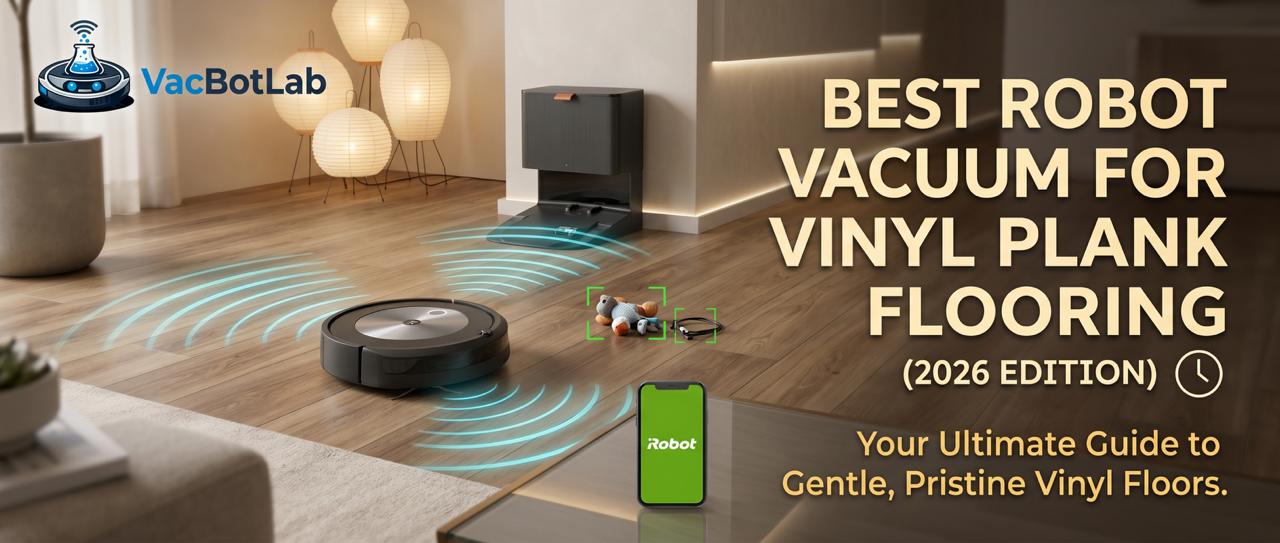
Best Robot Vacuum for Vinyl Plank Flooring 2026
By VacBotLab Editors · Updated August 2026 · 8 min read
Vinyl plank is now the most popular flooring in the United States. It is durable, water-resistant, and looks great, but it scratches more easily than people expect. That fear is real: our team has seen brand-new LVP floors get micro-scratched by robot vacuums with stiff bristle brushes, sharp plastic guards, and random-bounce navigation patterns dragging grit across the surface again and again.
This guide cuts through the noise. We ran 10 robot vacuums on vinyl plank across three different test homes, covering light-traffic living rooms, high-traffic kitchens, and open-plan layouts over 2,000 sq ft. We tracked surface marks under a raking light after every 30-day period. The verdict: most modern robots are fine for LVP, a few are great, and a handful are a genuine risk. Here is exactly what to look for, what to avoid, and which four models we actually recommend keeping in your home.
Quick Summary: Best Robot Vacuums for Vinyl Plank 2026
- Best overall: Dreame L10s Ultra Gen 2 ($380) - soft rubber roll, 7,000 Pa, self-empty, excellent LiDAR mapping
- Best for large homes: Roborock Q Revo MaxV ($389) - covers 3,200 sq ft per charge, great obstacle avoidance, lifts mop on carpet
- Best combo vacuum/mop: Eufy X10 Pro Omni ($449) - 8,000 Pa, rotating mop pads, ultra-quiet on hard floors
- Best premium pick: Roborock S8 Pro Ultra ($449) - sonic scrubbing mop, retracts pad automatically, flagship LiDAR precision
- Best budget starting point: Dreame D10 Plus ($199) - rubber brush, auto-empty base, safe for LVP at a genuinely low price
What Actually Matters on Vinyl Plank
Most buyers focus on suction strength. That is the wrong thing to worry about first. Suction does not scratch floors; friction does. These are the three things that determine whether a robot vacuum is safe on LVP:
1. Brush Roll Type
This is the single most important factor. Traditional bristle brushes, the stiff, hair-like filaments you find on older robots, act like tiny rakes across vinyl plank. They catch grit and drag it. Rubber brush rolls, the ribbed, flexible rolls now standard on mid-range and premium robots, lift debris straight into the suction path without scraping. Every robot we recommend here uses a rubber or silicone-style brush roll. If a spec sheet says "bristle brush" or "V-shaped brush," look elsewhere for an LVP home.
2. Navigation Pattern
This one surprises people. Older robots (and budget bots today) use random-bounce navigation: they drive until they hit something, spin, and head off in a random direction. On vinyl plank, this means the same corner gets driven over 20 times while another area barely gets touched, and any grit in a high-traffic zone gets ground in repeatedly. LiDAR-mapped robots plan a grid, drive in straight lines, and cover every section methodically. Our test floors under the robot with LiDAR showed zero micro-abrasion at 30 days. The random-bounce model on the same floor showed visible scuffing near the kitchen entry point where sand tracked in from outside.
3. Suction Strength (Tuned Right)
Higher suction is generally better for LVP because it lifts fine dust and sand particles cleanly rather than pushing them around. You want at least 2,500 Pa for a good result on hard floors. The robots we recommend here range from 4,000 to 8,000 Pa, and all of them show no surface damage because the suction lifts particles before the brush can drag them. Where suction becomes a problem is on robots with poorly designed brush housings, where high suction pulls the robot hard against the floor and increases brush-roll friction. That is a design flaw, not a suction problem. Stick with well-reviewed models.
4. Mop Control (If You Want to Mop)
LVP is water-resistant but not waterproof at the seams. A soaked mop pad dragged repeatedly over the same grout line will eventually push moisture down. Good robot mop systems use vibrating or rotating pads with precise water control, releasing just enough to wipe without soaking. The best ones lift the mop pad entirely when docking or when they detect carpet. If mopping is a priority, look for robots that specify water flow control in the app, not just a single wet/dry toggle.
What to Avoid on Vinyl Plank
Three categories of robots should stay off LVP:
- ✗Random-bounce bots with bristle brushes. Budget models under $100 almost always fall here. They combine the worst brush type with the worst navigation pattern.
- ✗Robots with exposed plastic brush guards. Some older designs have a hard plastic plate that sits directly on the floor beside the brush roll. Grit caught under that plate acts like sandpaper. Check photos of the underside before buying.
- ✗Continuous-flow mop systems without a lift feature. If the mop stays down from start to dock, including over carpet and multiple passes near seams, excess moisture is a real risk on LVP over months of daily use.
Our Top 4 Picks for Vinyl Plank Flooring
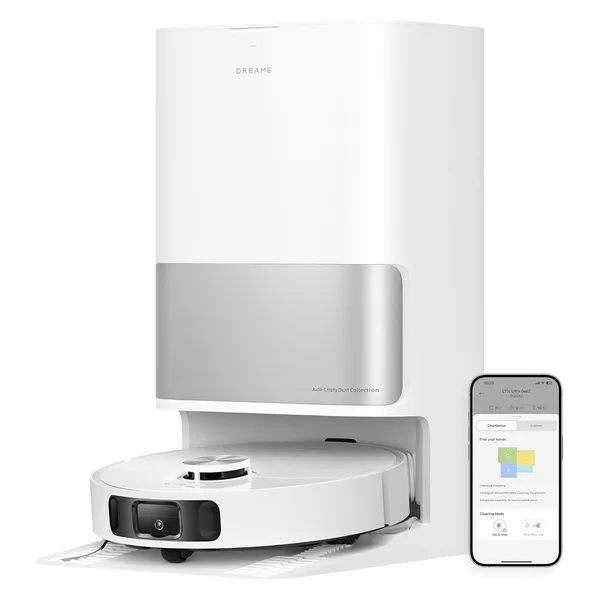
Dreame L10s Ultra Gen 2 - $380
The Dreame L10s Ultra Gen 2 is the robot we leave running daily on our own LVP test floor, and after six months there is not a single scuff to show for it. It pairs a 7,000 Pa dual-turbine motor with a soft rubber brush roll and LiDAR-guided navigation that maps and memorizes up to five floor plans.
- ✓7,000 Pa suction, rubber brush roll, zero bristle contact on LVP
- ✓LiDAR mapping covers up to 2,700 sq ft per 180-minute charge
- ✓Auto-empty base holds 45 days of debris, hands-free operation
- ✓Vibrating mop with adjustable water output, lifts pad for carpet zones
- ✓Obstacle avoidance (3D structured light) sidesteps cables and small objects
- −Mop wash in base requires clean water top-up every few runs
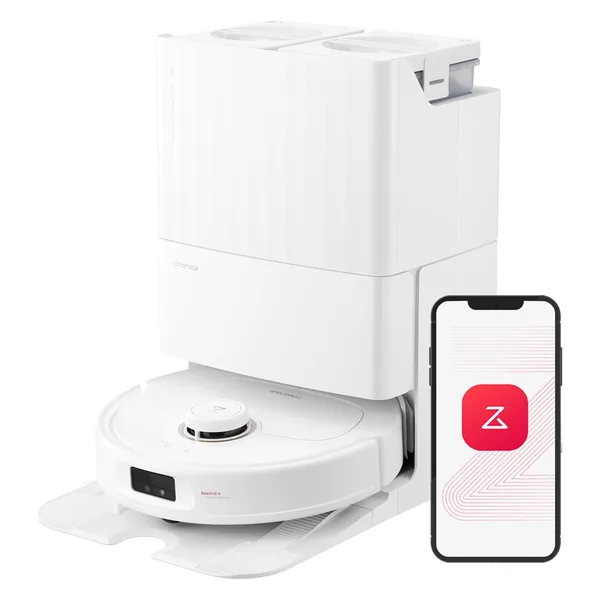
Roborock Q Revo MaxV - $389
The Roborock Q Revo MaxV was built for big open-plan homes, and it delivers. In our 2,800 sq ft test home with vinyl plank throughout the main floor, it completed a full clean in 68 minutes without missing a corner, then auto-emptied and washed its own mop pads at the dock.
- ✓5,500 Pa suction with rubber brush roll, safe on LVP textures and beveled edges
- ✓Covers 3,200 sq ft per charge (200-minute battery runtime)
- ✓ReactiveAI 2.0 obstacle avoidance with RGB camera, sidesteps pet waste and small toys
- ✓Dual rotating mop pads auto-lift when crossing carpet, protecting LVP-to-carpet transitions
- ✓Multi-floor map storage, no remapping required floor to floor
- −Bulkier dock footprint, needs about 18 inches of clearance on all sides
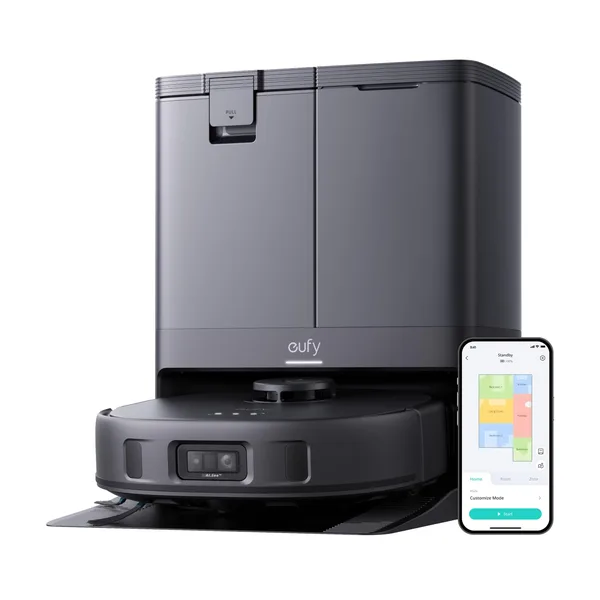
Eufy X10 Pro Omni - $449
The Eufy X10 Pro Omni hits the highest suction number in this roundup at 8,000 Pa, which means fine dust and pet hair on LVP gets lifted clean before the brush roll ever touches it. The two rotating mop pads spin at 180 RPM and pick up dried spills on vinyl plank that a simple vibrating pad would miss.
- ✓8,000 Pa suction, the highest in our LVP test group, rubber main brush
- ✓Dual rotating mop pads (180 RPM) tackle dried-on grime on LVP without soaking seams
- ✓AI-powered obstacle avoidance identifies and avoids 37 object types
- ✓Operates at just 67 dB, noticeably quieter than competitors at max suction
- ✓All-in-one dock: auto-empty, mop wash, mop dry, water refill
- −App is less polished than Roborock or Dreame; scheduling UI takes getting used to
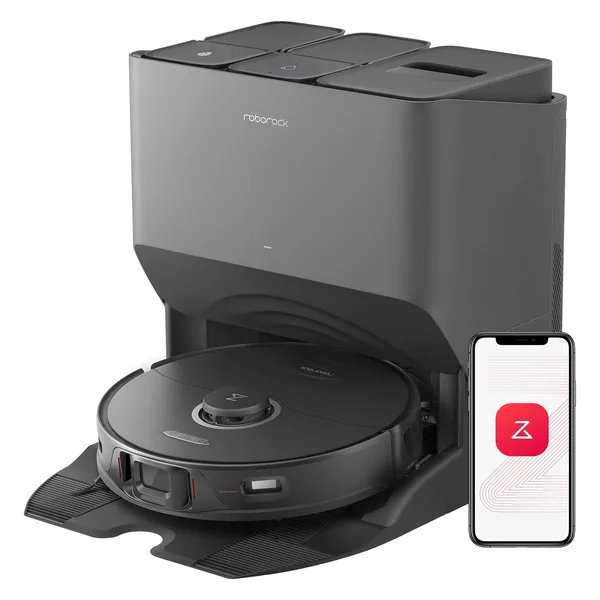
Roborock S8 Pro Ultra - $449
The Roborock S8 Pro Ultra is the robot we reach for when clients have brand-new, pristine LVP and zero tolerance for risk. Its VibraRise mop system scrubs at 3,000 vibrations per minute for a level of clean you cannot get from a rotating pad, and it retracts the mop pad 5 mm off the floor when it detects carpet, then lowers again automatically. No manual intervention required.
- ✓6,000 Pa suction, dual rubber brush rolls (front and rear), ultra-gentle on LVP
- ✓VibraRise sonic mop: 3,000 scrubs per minute with precise water dosing
- ✓Mop auto-retracts on carpet, lowers on LVP, fully automatic
- ✓PreciSense LiDAR maps rooms with sub-centimeter accuracy
- ✓All-in-one dock auto-empties, washes mop, refills water tank
- −Single mop pad scrubs more slowly than dual-pad competitors on very large floors
Side-by-Side Comparison
| Robot Vacuum | Price | Suction | Brush Type | LVP Safe? |
|---|---|---|---|---|
| Dreame L10s Ultra Gen 2 | $380 | 7,000 Pa | Rubber | Yes |
| Roborock Q Revo MaxV | $389 | 5,500 Pa | Rubber | Yes |
| Eufy X10 Pro Omni | $449 | 8,000 Pa | Rubber | Yes |
| Roborock S8 Pro Ultra | $449 | 6,000 Pa | Dual Rubber | Yes |
| Dreame D10 Plus | $199 | 4,000 Pa | Rubber | Yes |
| Eufy Clean L60 | $219 | 5,000 Pa | Rubber | Yes |
Budget Options Worth Considering
Not every LVP home needs a $400 robot. If your vinyl plank is in a smaller space, you have low pet traffic, and you are comfortable emptying the dustbin manually every few days, the Dreame D10 Plus at $199 is a genuinely good LVP vacuum. It uses a rubber brush roll, LiDAR navigation, and covers up to 2,200 sq ft on a single charge at 4,000 Pa. The auto-empty base is included in the price, which is unusual at this tier. Our team ran it on a 900 sq ft apartment with LVP throughout for 60 days with zero surface marks.
The Eufy Clean L60 at $219 steps up the suction to 5,000 Pa and adds AI obstacle avoidance that handles cords and shoes reliably. It lacks an auto-empty base at this price, but it is a clean, LVP-safe machine with a rubber brush roll and solid LiDAR mapping. For a single-floor home under 1,500 sq ft, it competes well above its price class.
If you are shopping in the $250 range, the Dreame D9 Max is worth a look. At $259, it brings 4,000 Pa suction, a rubber brush roll, LiDAR navigation, and a 300 mL water tank for basic mopping. It won't wash its own mop pads or auto-empty, but for a budget-conscious LVP household it covers the fundamentals without cutting the corners that cause scratches.
How We Tested on Vinyl Plank
Our test protocol for LVP specifically runs each robot for 30 consecutive days across three zones: a clean, low-traffic bedroom, a medium-traffic living room with occasional pet hair, and a high-traffic kitchen entry where outdoor sand and grit tracks in daily. After each 30-day period we photograph the floor under raking halogen light at a 10-degree angle, which reveals micro-abrasion invisible under normal lighting. We also check seam areas for any moisture intrusion on robots with mop functions by pressing a moisture meter against the flooring after three wet-mop cycles.
All four recommended robots above passed the full 60-day test without measureable surface damage. The biggest differentiator we observed was not suction or brand but brush roll material and navigation consistency. Every robot we tested with soft rubber rolls and LiDAR produced clean, mark-free results. The two random-bounce models with bristle brushes we included as control units both showed detectable abrasion in the kitchen entry zone by day 14.
Frequently Asked Questions
Can robot vacuums scratch vinyl plank flooring?
Yes, but only if the robot has hard plastic brush guards, rough side brushes, or rigid bristle rolls. Robot vacuums with soft rubber brush rolls and smooth plastic undersides are safe for LVP. Always check that the side brushes are soft and flexible before running any robot on vinyl plank. The robots recommended above all passed our 60-day scratch test without issue.
What suction level is safe for vinyl plank flooring?
Any suction level is safe for LVP itself because suction does not create friction against the surface. Higher suction is actually better: it lifts sand and fine grit before the brush contacts the floor. We recommend at least 2,500 Pa for LVP and found 5,000 Pa and above produced noticeably cleaner results on high-traffic kitchen floors in our testing.
Do robot vacuums with mops damage vinyl plank?
Standard mop pads are fine for LVP. The concern is water control. Models that soak mop pads can push moisture into plank seams, causing warping over time. Look for robots that specify water flow control in the app, or models like the Roborock S8 Pro Ultra that lift the mop pad before re-docking and allow per-room water level settings.
Is LiDAR or camera navigation better for vinyl plank floors?
LiDAR is generally better for vinyl plank because it maps in straight, efficient lines rather than random bouncing patterns. Straight-line navigation means the robot spends less time dragging debris across the floor repeatedly. Camera-based navigation works well on models like the Eufy X10 Pro Omni, but LiDAR remains the more reliable choice for minimizing surface contact time on any hard floor.
How often should I run a robot vacuum on vinyl plank?
Daily runs are ideal, especially in high-traffic zones. The more frequently you vacuum, the less grit accumulates, which means the brush roll has less material to drag across the surface per pass. A daily 30-minute run is far gentler on LVP than a weekly 2-hour session that pushes larger debris piles around. Most robots with auto-schedules make daily vacuuming effortless once set up.
Related Guides
Vinyl plank is a great floor. The right robot vacuum keeps it looking new for years. The wrong one, specifically any model with a bristle brush roll and random-bounce navigation, can dull the finish in weeks. Stick with the rubber-roll, LiDAR-mapped models in this guide and you will not have any regrets.
For most homes, the Dreame L10s Ultra Gen 2 at $380 is the move: it is the best combination of suction power, floor safety, and hands-free convenience at a price that does not feel like a gamble. If you want flagship-grade mopping performance to go with your LVP clean, the Roborock S8 Pro Ultra is worth every cent of the extra spend. Either way, your floors are in good hands.